Sauna masters speak · Scents
Are a lot of scents used during the sauna?
28 Oct 2026
How would you advise using them? Can anything be used to create scents in the sauna? For example, a splash of beer in the water before pouring it onto the stones, or a crushed garlic clove in the water?
Translated automatically from Lithuanian ·

Yes, this is one of the most subtle parts of the Lithuanian sauna, because a pleasant scent relaxes you, drives away even the bad thoughts that were raging in your head just a moment ago, and calms you. It even seems to erase fatigue.
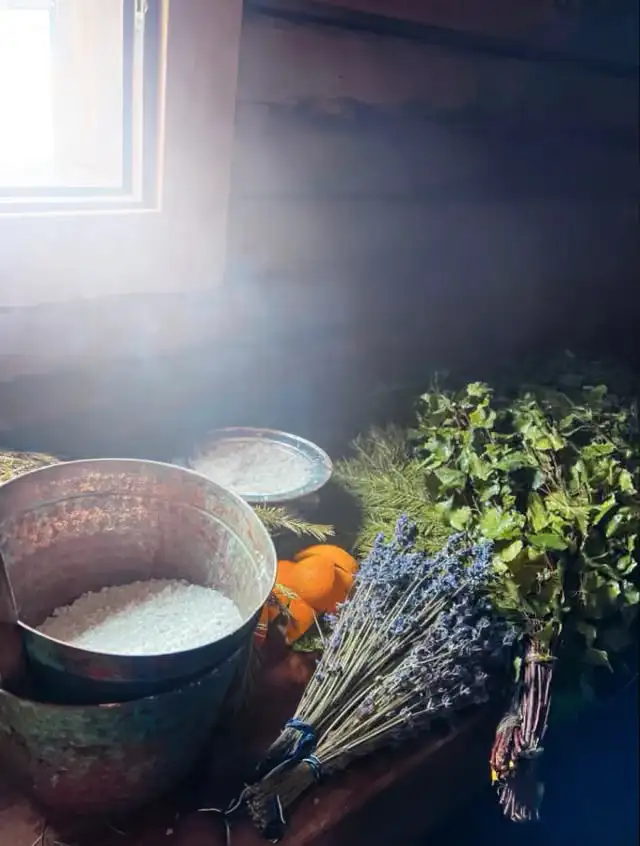
I talk about scents in the sauna often; I have to say a lot on this topic and answer sauna participants' questions. My favourite comparison: we can safely put on our body what we eat, but that doesn't mean you should haul cod liver into the sauna and smear yourself with it.
It's the same with scents. One of the main sauna rules: we pour water on the stones, and only water. Why? Because the various fragrances poured on the stones turn into a plain burnt smell, not a delicious aroma. In some cases, harmful substances can even form. Essential oils, whether or not the label says they are meant for the sauna, burn, do not dissolve in either hot or cold water, and so on.
If you like a particular essential oil, it's better to hang a metal bowl of water above the stove stones and add a few drops of essential oil to it.
Pour on some steam, pass it through a peppermint or other fragrant sauna whisk and let it warm up. Wave it a few times and you'll smell the steam room fill with a pleasant aroma.
Fill a spray bottle with an extract or decoction, for example of southernwood. A few sprays, and your sauna will be carried away to the distant expanses of nature's aromas.
Beer and garlic fans. A difficult case, a separate species. Pouring beer on sauna stones came from the Soviet era. In some places people try to claim it's a tradition, although in reality it ruins the sauna stones and the air. Although this „etnografinis paveldas“ (ethnographic heritage) is still alive and well, more and more people realise that doing this is bad form.
I call garlic lovers a sect of radical ayatollahs whose members know only one „tiesą“ (truth): „Garlic is good everywhere and for everything!“, „Česnakas – natūralus antibiotikas“ (Garlic is a natural antibiotic) (a completely false claim), and they don't care about the opinion of professional sauna masters.
Even knowing how beneficial garlic is, pouring its extracts on the stones is a bad and dangerous habit. The stones of ordinary wood-fired or electric sauna stoves heat up to 150–250°C on the surface where water is poured. Garlic's beneficial substance, allicin, is most active at a temperature of 23–25°C, and it begins to break down at 40–45 °C (the decomposition speeds up as much as 100 times; at 70–75°C it breaks down abruptly and secondary sulphur compounds are released). Once the allicin is destroyed, a dangerous carcinogen, acrylamide, forms, which loads the lungs with carcinogens and strongly irritates the mucous membranes.
That's why, before bringing anything to the sauna, you should always look into it more deeply. Just because your uncle or grandfather did it out of ignorance doesn't mean it's harmless.
Etiquette plays an important role. Far from everyone likes or wants the smell of garlic in the sauna, so if you do it, and I stress, even in your own sauna, you must ask your guests first. Unfortunately, visitors to rented or public saunas very often ignore other people's remarks and pour this poison on the stones anyway.
After all, there are plenty of other ways to scent the sauna air that pose no danger at all to health.
To sum up, sauna lovers think that anything can be used in the sauna, while professional sauna masters, especially those who provide services, know that not everything can be used. Between „manau“ (I think) and „žinau“ (I know) there is a difference as wide as an abyss.
The perfect time for a sauna
Find a sauna nearby and pick a time - and let a sauna master lead the ritual.